How to Remember Your Dreams: 7 Proven Tips
The short answer
Frequent dream recall is a habit you can build. Set the intention to remember before sleep, stay still when you wake, record the dream immediately - even one image - and keep a dream journal every day. Waking near the end of a REM period and getting enough sleep also help. Most people notice more dreams within a week or two.
In this article
You wake up in the middle of something vivid - a conversation, a chase, a house you have never seen - and by the time you have brushed your teeth, it is gone. Only a feeling remains. That disappearing act is normal, and it is also the most fixable thing about dreaming. Remembering dreams is a skill, and it responds quickly to practice.
Why dreams vanish within minutes
First, the reassuring part: you almost certainly dream every night. Eugene Aserinsky and Nathaniel Kleitman discovered in 1953 that people woken from REM sleep usually report vivid dreams, and a 2017 study led by Siclari showed that dreaming happens in both REM and non-REM sleep. Not remembering is not the same as not dreaming - more on that in why you think you don’t dream.
So why do dreams fade so fast? The common explanation is that the sleeping brain is not set up to store new memories the way it does during the day. When you wake, the dream exists in a fragile, short-term form. If you move, open your eyes to a bright screen or start thinking about your to-do list, the new input overwrites it within minutes.
Dreams are also strange. They mix fragments of recent and older memories, as Erin Wamsley and Robert Stickgold describe, and they rarely follow a logical plot. Our memory holds on to stories with clear structure; a dream that jumps from your office to a beach with your childhood dog has nothing to hang on to.
That is also why some mornings feel empty even after a night full of dreams. If you wake from deep sleep rather than from a dream, or wake slowly to an alarm and start thinking about the day, there is little left to catch. The tips below work on both problems: they help you wake closer to a dream, and they protect the memory in the first minute after waking. None of them needs special equipment, and most take less time than making coffee.
What science says about frequent dream recall
Researchers have studied why some people remember dreams almost every morning while others rarely do.
Part of it seems to be the brain itself. A 2014 study led by Jean-Eichenlaub found that high dream recallers show different resting brain activity, in areas called the temporo-parietal junction and the medial prefrontal cortex. Frequent dream recall, in other words, partly reflects natural differences between people.
But habits matter a lot too. A 2016 study by Aspy found that people recall more dreams in a logbook than they estimate in questionnaires - many of us underestimate how much we dream - and that keeping a log increases recall. Simply paying attention to dreams brings more of them back.
There is also a reason dreams are worth remembering. Michael Schredl’s research on continuity shows that waking activities and concerns show up in dream content. The dreams you recall are a window onto what is on your mind, which is why recall is the first step of any interpretation.
7 tips to remember your dreams
These tips work together. Start with the first three and add the rest as they fit your life.
1. Set the intention before sleep
As you fall asleep, tell yourself clearly: “When I wake up, I will remember my dream.” It sounds too simple, but intention shapes what you notice on waking. Stephen LaBerge built his MILD lucid dreaming technique on the same idea of a bedtime intention.
2. Do not move when you wake
Before you open your eyes, reach for your phone or roll over, stay exactly as you are. Ask: “What was I just dreaming?” Many people find that returning to the position they woke in brings back more detail. This first minute is when most dreams are won or lost.
3. Record it immediately
Write or speak the dream before you do anything else, even if you only have one image or a feeling. Speaking is faster than writing when you are half-awake, and voice notes catch details your hand would skip. Do not judge or edit - just get it down. Keywords are enough at first: “train, grandmother, water rising, scared”. You can fill in the story once the essentials are safe.
4. Pull the thread from one fragment
If all you have is a scrap - a color, a face, a sense of dread - start there. Ask what came just before, who else was there, where you were. Fragments often unroll into whole scenes. Recording the feeling first also helps, since emotion tends to be the part that lingers longest.
5. Wake up near a dream
Sleep runs in cycles, and REM periods grow longer toward morning. Waking naturally, without a blaring alarm, gives you the best chance to wake out of a dream. On days off, let yourself sleep in. Some people set a gentle alarm a little earlier or later than usual to catch a different point in the cycle. Even short naps can produce vivid dreams, as dreaming during naps explains.
6. Keep a dream journal every day
This is the tip with the clearest research support. Recording every morning - including “nothing remembered” - trains attention and, as Aspy’s study found, increases recall. After two or three weeks you will also start to see patterns, which is when dreams become genuinely interesting.
7. Protect your sleep
Short, broken sleep means fewer long REM periods and more grogginess on waking, and both cost you dreams. A regular schedule and enough time in bed are the foundation. If you are tired all the time, recall is the least of the reasons to look at your sleep.
| Tip | Why it helps | Effort |
|---|---|---|
| Set an intention | Primes you to notice the dream on waking | Seconds |
| Stay still | Avoids overwriting a fragile memory | One minute |
| Record immediately | Captures details before they fade | One minute |
| Pull the thread | Turns a fragment into a scene | A few minutes |
| Wake near a dream | Late-night REM periods are longest | Schedule change |
| Daily journal | Shown to increase recall | A few minutes a day |
| Protect your sleep | More REM, clearer waking | Ongoing |
Context: why your recall changes
Recall is not fixed. The same person can remember dreams every day for a month and then go quiet.
Stress and big life events. Busy, emotional periods often bring more vivid dreams - or, when you are exhausted, fewer remembered ones. See why your dreams are so vivid.
Changes in habits. People who stop using cannabis often report a sudden flood of dreams, covered in dreams after quitting weed. Changes in schedule, travel and new routines can also shift recall.
Your attention. The more you care about dreams, the more you remember. Interest alone, without a journal, already helps a little.
How you wake. Alarms, children, pets and phones all cut the first minute short. When recall drops, look at your mornings before anything else.
The cultural view
Keeping track of dreams is an old habit. Many families and cultures share dreams at breakfast, and writers, artists and scientists have kept dream notebooks for centuries. Deirdre Barrett’s book The Committee of Sleep collects stories of how dreams have contributed to creative and problem-solving insight, and describes dream incubation: going to sleep with a question in mind.
Whether you see dreams as psychological, spiritual or simply fascinating, remembering them is the shared starting point. You cannot reflect on, interpret or steer a dream you have already forgotten.
How to start a dream journal that lasts
A journal only works if you keep it, so make it effortless.
- Keep it by the bed. A notebook and pen, or your phone on silent with a voice note ready.
- Use the same fields. Date, the dream, the main emotion, people and key symbols, a line about yesterday, and “repeat?”. Fixed fields make patterns visible.
- Pick your focus. A dream interpretation journal adds your associations and a question - “what in my life feels like this?”. A lucid dreaming journal highlights dreamsigns and near-lucid moments; see lucid dreaming techniques for beginners.
- Record “no dream” too. It keeps the habit alive on quiet mornings.
- Review weekly. Look for repeating places, people and feelings.
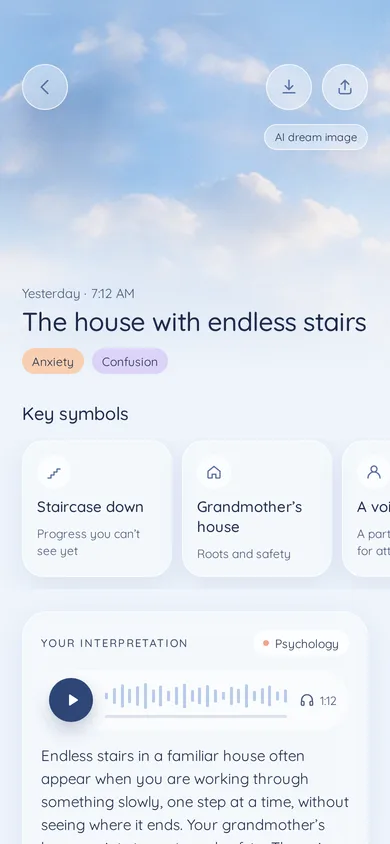
Here is what a quick entry can look like: “Oct 1. At my old school, looking for a classroom, hallways keep changing. Felt: lost, a bit anxious. People: my sister. Symbols: hallway, classroom, a locked door. Yesterday: first day on the new project. Repeat: yes, third school dream this month.” It takes a minute, and three weeks of entries like this tell you more than any dream dictionary.
The most common mistakes are waiting until later to write (the dream is gone by then), trying to write beautifully, and giving up after a few blank mornings. Blank mornings are part of the process. Recall usually returns in waves, and the journal is what keeps you ready for them.
When you have a dream worth exploring, use our five-step method to interpret your dream, read about how AI dream interpretation works, or check what science says about dream interpretation. Frequent dream recall makes all of them better: the more dreams you keep, the clearer your story.
Frequently asked questions
How do I remember my dreams every night?
Nobody remembers every dream, but you can remember far more. The core routine is simple: decide before sleep that you will remember, stay still with your eyes closed when you wake, replay the dream, then record it before doing anything else. Do it every morning, even when you only recall a feeling. Consistency matters more than any single trick.
Why do I forget my dreams so quickly?
Dreams are fragile memories. The common explanation is that the sleeping brain is not set up to store new memories the way it does during the day, so a dream exists mostly in short-term memory when you wake. Moving, checking your phone or thinking about your day quickly overwrites it. Holding still and replaying the dream gives it a chance to stick.
What should a dream interpretation journal include?
A dream interpretation journal works best with a few fixed fields: the date, the dream in your own words, the main emotion, the people and key symbols, a line about what happened the day before, and whether it is a repeat. Over weeks, those fields reveal your recurring themes - which is where most of the meaning shows up.
How is a lucid dreaming journal different?
A lucid dreaming journal focuses on dreamsigns - the odd things that keep showing up in your dreams, such as a certain place, a recurring person or broken technology. Highlight them, note any moment you almost realized you were dreaming, and record lucid dreams in detail. The aim is to learn your personal cues so you notice them inside the next dream.
Is it normal not to remember any dreams?
Yes, many people go through stretches of remembering almost nothing, and some rarely recall dreams at all. Research shows dreaming happens in both REM and non-REM sleep, so you almost certainly dream every night. Recall depends on habits, sleep patterns and natural differences between people. A few weeks of journaling usually brings some dreams back.
Sources
- Aspy, D. J. (2016). Is dream recall underestimated by retrospective measures and enhanced by keeping a logbook? An empirical investigation. Consciousness and Cognition, 42, 181-203.
- Eichenlaub, J.-B., Nicolas, A., Daltrozzo, J., Redouté, J., Costes, N., & Ruby, P. (2014). Resting brain activity varies with dream recall frequency between subjects. Neuropsychopharmacology, 39(7), 1594-1602.
- Aserinsky, E., & Kleitman, N. (1953). Regularly occurring periods of eye motility, and concomitant phenomena, during sleep. Science, 118(3062), 273-274.
- Siclari, F., Baird, B., Perogamvros, L., Bernardi, G., LaRocque, J. J., Riedner, B., et al. (2017). The neural correlates of dreaming. Nature Neuroscience, 20(6), 872-878.
- Wamsley, E. J., & Stickgold, R. (2011). Memory, sleep and dreaming: Experiencing consolidation. Sleep Medicine Clinics, 6(1), 97-108.
- Schredl, M., & Hofmann, F. (2003). Continuity between waking activities and dream activities. Consciousness and Cognition, 12(2), 298-308.
- Barrett, D. (2001). The Committee of Sleep. Crown.
- LaBerge, S. (1985). Lucid Dreaming. Jeremy P. Tarcher.
Dreamer is a tool for reflection, not medical or psychological care. If dreams keep you from sleeping or living well, talk to a doctor or a therapist.