AI Dream Interpretation: How It Works and Which App to Use
The short answer
Dream interpretation AI reads your description of a dream, picks out the symbols, people, setting and emotions, and connects them to what you say about your life to suggest what the dream may reflect. The best tools add context and a journal that tracks patterns over time. They support reflection - they do not predict the future or replace therapy.
In this article
People have always wanted someone to talk to about their dreams - a grandmother, a priest, a therapist, a dream book on the nightstand. AI is the newest listener. It is fast, available at 6 a.m. and does not mind hearing the same dream for the fifth time. The question is what it actually does with your dream, and how to tell a useful tool from a fortune-telling machine.
How dream interpretation AI works
Under the hood, dream interpretation AI uses a large language model - the same kind of technology behind modern chatbots - guided by instructions about how to read dreams. A good tool works in roughly five steps.
- It takes your description. Typed or spoken, the dream becomes text. Details matter: who was there, where you were, what changed, how it ended.
- It pulls out the building blocks. Symbols (a house, a snake, water), characters (your ex, a stranger, a parent), actions (chasing, falling, searching) and, crucially, emotions.
- It adds your context. How the dream felt, whether it repeats, what is going on in your life. Without context, any reading is a guess.
- It writes a reading. It connects the building blocks to common interpretations and to your situation, ideally offering possibilities rather than verdicts.
- It remembers. The best tools keep a journal and compare tonight’s dream with earlier ones, which is where the most useful insights tend to appear.
What it cannot do matters just as much. AI does not know anything about you that you have not shared. It does not have access to hidden meanings or the future. And like any language model, it can sound more confident than it should - so a good tool frames its reading as questions to consider, not facts.
What sleep science says about reading dreams
AI did not invent a new way of understanding dreams. The useful tools borrow from what dream research already shows.
The first principle is continuity. Michael Schredl and colleagues showed that waking activities and concerns show up in dream content. That is why a reading that ignores your life is shallow: the material of the dream comes from your days. A 2014 study by Malinowski and Horton found that emotionally intense waking experiences are more likely to appear in dreams than neutral ones - so the emotion is often the key to the whole dream. Matthew Walker’s review of REM sleep and emotional processing points the same way: dreams seem to work on feelings.
The second principle is pattern. G. William Domhoff’s research found that a person’s dream content is consistent over time and reflects their concerns and relationships. One dream is a snapshot; twenty dreams are a portrait. Calvin Hall and Van de Castle built the standard system for coding dream content - characters, emotions, misfortunes, aggression - which is, in spirit, what a careful AI does with each dream you record.
The third principle is association. In their book When Brains Dream, Antonio Zadra and Robert Stickgold propose that dreaming explores weak, unexpected associations between memories. A dream is less a coded message than a mind trying out connections, which is why “what does this remind you of?” is often the best question.
Finally, dream work has a track record in therapy. Clara Hill developed a structured method moving from exploration to insight to action, and a review by Pesant and Zadra found that dream work in therapy can increase insight and engagement, although the evidence is promising rather than conclusive. An AI tool is not therapy, but it can borrow the same humble structure: explore, reflect, then ask what you might do.
Dream dictionary vs ChatGPT vs a dream interpretation app
There are four main ways people interpret dreams today. Each has a place.
Dream dictionaries
Books and websites that list symbols and meanings. They are free and quick, and they capture traditional readings. But they give the same answer to everyone: a snake means transformation whether you were calmly watching it or running for your life. They cannot see your feelings, your life or your history of dreams.
General chatbots: dream interpretation with ChatGPT
A general-purpose chatbot can give a surprisingly thoughtful reading if you give it a detailed description plus your feelings and situation. The limits are practical. You have to write a good prompt, remember to add context, and keep your own journal if you want to see patterns. Half-awake at 6 a.m., most people type one line and get a generic answer. How your text is stored depends on that service and your settings.
Dream journal apps
Journals make it easy to record dreams and sometimes tag them. They are great for recall, which is the foundation of any interpretation, but many leave the interpretation to you.
Dedicated dream interpretation apps
Apps built for dreams combine the journal with interpretation. Quality varies a lot: some are dream dictionaries with a new interface, others ask for context and track patterns. Look for the features in the table below rather than for bold promises.
How Dreamer works
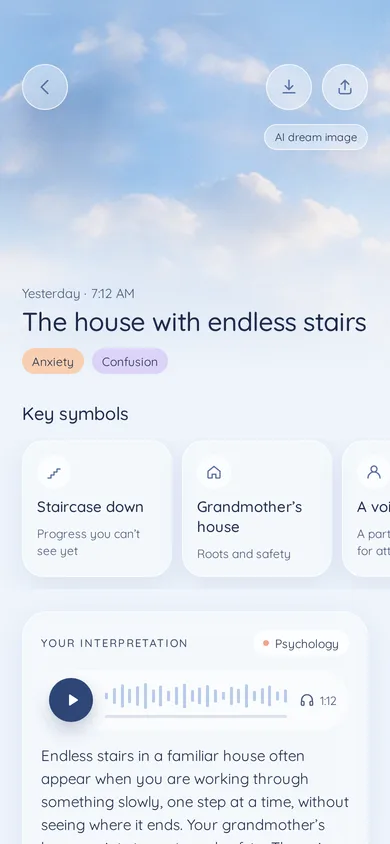
Dreamer is an iPhone app built around the research view above. You tell your dream out loud right after waking - about 10 seconds is enough - then mark how it felt (anxiety, confusion, calm, joy or fear), whether it repeats and whether someone specific was in it. You get:
- A personal interpretation in three lenses - Psychology, Spiritual and Dream book. You choose the main one; the other two are a tap away.
- The three key symbols of your dream, with what each one means in your version.
- “For you, right now” - a short note and a question to carry into your day.
- An AI-generated image of your dream and a voice read-out of the interpretation.
- A journal that surfaces your recurring symbols and emotions over time, plus a symbol library.
Dream texts are encrypted on Dreamer’s servers. It costs $39.99 a year with a 7-day free trial, or $6.99 a week. It is a tool for reflection, not therapy, and it makes no predictions.
| Dream dictionary | General chatbot | Dream journal app | Dreamer | |
|---|---|---|---|---|
| Reads the whole dream | No, one symbol at a time | Yes, if you describe it well | Usually not | Yes |
| Asks how it felt | No | Only if you add it | Sometimes as a tag | Yes, built in |
| Uses your life context | No | Only if you add it | No | Yes |
| Tracks patterns over time | No | Not by design | Partly | Recurring symbols and emotions |
| Voice input on waking | No | Depends | Some | Yes, about 10 seconds |
| Dream image and read-out | No | Depends | Rarely | Yes |
| Cost | Free | Free or subscription | Varies | $39.99/year or $6.99/week |
Context: why the same dream gets different readings
The biggest difference between a generic reading and a useful one is context. Three pieces change the meaning of almost any dream.
The emotion. Losing your teeth while feeling relieved is a different dream from losing them in panic. See how much the feeling matters in teeth falling out dreams or dreams about snakes.
Your situation. Dreaming about your ex during a breakup, years later, or the week before a wedding are three different dreams. Our guide to dreaming about your ex walks through those cases.
Repetition. A one-off chase is a bad night. A chase that returns every exam season is a pattern - see why you keep having the same recurring dream and being chased in dreams.
This is exactly what a dictionary cannot see, and what a good dream interpretation AI should ask about before it answers.
Psychology, spiritual or dream book: choosing a lens
Dreams have been read through many lenses, and no single one owns the truth. Dreamer offers three because people genuinely differ in what helps them.
Psychology reads the dream through sleep research and emotion: what concern, feeling or relationship the dream may be working on. This is the lens closest to the science above, and to Carl Jung’s idea that dreams compensate for what the waking mind leaves out.
Spiritual reads the dream as many traditions do - as a mirror for growth, transition and meaning. It is offered as one way of reflecting, never as a message from above.
Dream book gives the traditional symbol meanings that dream dictionaries have collected, useful as cultural background and often fun to compare with the other two.
Seeing all three side by side is itself a lesson: if the same image can be read three ways, the meaning depends on you. If you want to know where the evidence stands, read is dream interpretation real.
How to get a good AI dream reading
Whatever tool you use, the quality of the reading depends on what you give it.
- Record it immediately. Dreams fade within minutes of waking. Speaking is faster than typing - more tips in how to remember your dreams.
- Include the feeling. One honest word - scared, relieved, ashamed - changes the reading more than any symbol.
- Add a line about your life. A new job, a fight, a move. The AI cannot guess it.
- Mention repeats and people. If you have had the dream before, or a specific person was there, say so.
- Treat the reading as a question. Ask yourself what fits and what does not. You are the expert on your life.
- Keep going. Patterns across weeks are more revealing than any single dream.
AI for dream interpretation works best alongside your own reflection, not instead of it. If you would rather work through a dream by hand first, follow our five-step method to interpret your dream. And if dreams keep you from sleeping or living well, especially after a loss - see dreaming of someone who passed away - it is worth talking to a doctor or a therapist.
Frequently asked questions
Can AI really interpret dreams?
AI can do the part of interpretation that is about language and patterns: noticing the symbols, emotions and people in your dream, connecting them to what you say about your life and to common readings, and spotting themes across many dreams. It cannot know what you have not told it, and it is not a therapist or a fortune teller. Used as a reflection partner, it can be genuinely useful.
Is ChatGPT good for dream interpretation?
A general chatbot like ChatGPT can give a thoughtful reading if you describe the dream in detail and add your feelings and life context yourself. Its limits are about workflow rather than intelligence: you have to write the prompt, supply context each time and organize your own dream journal. A dedicated dream interpretation app builds those steps in, so you can do it half-awake.
What is the best dream interpretation app?
The best dream interpretation app for you is one that asks for context, not just symbols; keeps your dreams in a journal and shows what repeats; is clear about what it is - reflection, not prediction or therapy; and protects your dream texts. Dreamer was built around those points, with voice input, three lenses, key symbols, a dream image and an encrypted journal.
Is AI for dream interpretation private?
It depends on the service, so check before you share. Dreams can be very personal, so look for clear statements on how your text is stored, whether it is encrypted and whether it is used for anything beyond your interpretation. Dreamer encrypts dream texts on its servers. For any tool, it is fair to leave out names or details you would not want stored.
How is dream meaning AI different from a dream dictionary?
A dream dictionary gives one fixed meaning per symbol, the same for everyone. Dream meaning AI can weigh the whole dream - the plot, how it felt, who was there - against your situation, so a snake in a calm dream and a snake in a terrifying one get different readings. It can also compare tonight with your previous dreams, which a dictionary cannot do.
Sources
- Schredl, M., & Hofmann, F. (2003). Continuity between waking activities and dream activities. Consciousness and Cognition, 12(2), 298-308.
- Domhoff, G. W. (2003). The Scientific Study of Dreams: Neural Networks, Cognitive Development, and Content Analysis. American Psychological Association.
- Hall, C. S., & Van de Castle, R. L. (1966). The Content Analysis of Dreams. Appleton-Century-Crofts.
- Malinowski, J. E., & Horton, C. L. (2014). Evidence for the preferential incorporation of emotional waking-life experiences into dreams. Dreaming, 24(1), 18-31.
- Walker, M. P., & van der Helm, E. (2009). Overnight therapy? The role of sleep in emotional brain processing. Psychological Bulletin, 135(5), 731-748.
- Zadra, A., & Stickgold, R. (2021). When Brains Dream: Exploring the Science and Mystery of Sleep. W. W. Norton.
- Hill, C. E. (1996). Working with Dreams in Psychotherapy. Guilford Press.
- Pesant, N., & Zadra, A. (2004). Working with dreams in therapy: What do we know and what should we do? Clinical Psychology Review, 24(5), 489-512.
- Jung, C. G. (1964). Man and His Symbols. Doubleday.
Dreamer is a tool for reflection, not medical or psychological care. If dreams keep you from sleeping or living well, talk to a doctor or a therapist.