Is Dream Interpretation Real? What Science Actually Says
The short answer
Is dream interpretation real? Partly. Research shows dreams reflect your waking concerns, emotions and relationships, so exploring a dream can reveal what is on your mind. What science does not support is fixed symbol meanings that apply to everyone, hidden codes with one correct answer, or dreams that predict the future.
In this article
Dream interpretation has a credibility problem. Search for any dream and you will find pages that say snakes mean betrayal, teeth mean death and a white horse means good news is coming. Then you hear that scientists think dreams are random brain noise. The truth sits between those extremes, and it is more interesting than either.
Is dream interpretation real? It depends on the claim
“Dream interpretation” covers very different claims. Separating them answers most of the question.
Claim 1: dreams predict the future. Not supported. There is no scientific evidence that dreams foretell events. Dreams can feel prophetic because they draw on worries and expectations that later come true - more on that in why you dream things before they happen.
Claim 2: each symbol has one universal meaning. Not supported. The same image appears in very different dreams for very different people. A dream dictionary that gives one answer for everyone is offering folklore, not findings.
Claim 3: dreams are a coded message with one correct solution. Mostly not supported. This was Freud’s view, and modern research has moved away from its specifics.
Claim 4: dreams reflect your concerns, emotions and relationships, and exploring them can help you understand yourself. Supported. This is where the evidence is, and it is what a careful interpretation does.
So is dream interpretation real? Yes, as structured self-reflection grounded in what dreams are made of. No, as fortune-telling or decoding.
What science says about dream meaning
The strongest skeptical theory came from J. Allan Hobson and Robert McCarley in 1977. Their activation-synthesis hypothesis proposed that brainstem activity during REM sleep generates signals, which the forebrain weaves into a story. It is often summarized as “dreams are noise”. But even in this model, the story is built from your memories, worries and associations - so its content still says something about you.
Since then, a large body of research has looked at what dreams actually contain. Calvin Hall and Van de Castle created the standard system for coding dream content - characters, emotions, misfortunes, aggression - which allowed dreams to be studied like any other data. G. William Domhoff used such methods to show that a person’s dream content is consistent over time and reflects their concerns and relationships. Michael Schredl’s work on continuity found that waking activities and concerns show up in dream content.
Other studies point to function. A review by Matthew Walker and van der Helm describes REM sleep processing emotional memories while softening their charge. In a 2010 study led by Erin Wamsley, people who dreamed about a virtual maze task during a nap improved on it much more than those who did not. Rosalind Cartwright found that people going through divorce whose dreams engaged with the ex-spouse and their feelings were more likely to be in remission from depression a year later.
And Antonio Zadra and Robert Stickgold’s NEXTUP model proposes that dreaming explores weak, unexpected associations between memories to make sense of possibilities. If that is right, a dream’s meaning lives in the associations it makes - which only the dreamer can fully recognize.
From Freud to modern research: the main schools
Freud: dreams as disguised wishes
Sigmund Freud’s The Interpretation of Dreams, published in 1900, launched modern dream interpretation. He argued that dreams are disguised wish fulfilment, with symbols hiding forbidden desires. His insistence that dreams are meaningful was influential; his specific claims, such as fixed sexual symbols and universal wish fulfilment, are not supported by research.
Jung: dreams as compensation
Carl Jung broke with Freud. In Jung’s view, dreams compensate for the conscious attitude - they show what the waking mind leaves out. He worked with personal symbols and collective ones shared across cultures. Dream interpretation in the Jungian style asks what the dream adds to how you see your life. His archetypes remain unproven, but his focus on the dreamer’s own situation fits modern findings well.
Activation-synthesis: the skeptics
Hobson and McCarley shifted attention to the brain and challenged the idea of hidden messages. Their model is a useful corrective: not every detail of a dream needs a meaning, and bizarre elements may simply reflect how the dreaming brain works.
The cognitive view: continuity and content
Content analysis turned dreams into data. Its main lesson is plain but powerful: dreams are continuous with waking life. Your dreams are about the people, worries and activities that fill your days, often in exaggerated or recombined form.
Emotion and memory
Research on REM sleep, memory consolidation and emotional processing suggests dreams are part of how the brain handles experience. Emotion is the thread most likely to carry meaning from day to dream.
Dream work in therapy
Clara Hill developed a structured method for working with dreams in therapy: exploration, insight, action. A review by Pesant and Antonio Zadra found that dream work can increase insight and engagement in therapy, though the evidence is promising rather than conclusive. Here, meaning comes from conversation, not from a dictionary.
| Approach | Core idea | What holds up today |
|---|---|---|
| Freud | Dreams disguise wishes | That dreams are meaningful; not his specific symbols |
| Jung | Dreams compensate waking attitudes | Focus on the dreamer’s situation; archetypes unproven |
| Activation-synthesis | The brain weaves signals into a story | Not every detail needs meaning |
| Continuity and content analysis | Dreams reflect waking concerns | Well supported |
| Emotion and memory | Dreams are part of processing experience | Supported, still being studied |
| Dream work in therapy | Meaning comes from exploration | Promising, limited evidence |
Where dream books go wrong, and what you can really learn
The traditional dream book makes three mistakes that research corrects.
It ignores emotion. A dream about falling that ends in flying and one that ends in terror get the same entry. Yet emotion is the element most tied to waking life.
It ignores the dreamer. A dog means one thing to someone who grew up with a beloved pet and another to someone who was bitten. Associations are personal.
It ignores the body and the brain. Take teeth dreams. Dream books link them to death or money. A 2018 study by Rozen and Soffer-Dudek found teeth dreams were linked to dental irritation on waking, such as clenching, and less clearly to psychological distress. Sometimes the meaning is partly physical - see teeth falling out dreams.
What can you really learn from a dream? Which emotions are active in you right now. Which people and situations occupy your mind. Which concerns keep returning. And, through the dream’s odd associations, connections you had not noticed while awake. That is a lot - it just is not prophecy.
Here is the difference in practice. Say you dream that your house is flooding while you try to save old photo albums. A dream book might say water means wealth or misfortune. A research-style reading asks different questions: what did you feel - panic, grief, determination? What has been overwhelming lately? What feels precious and at risk? If you have just moved your parents into care, or are clearing out a childhood home, the dream suddenly makes sense - not as a forecast, but as your mind working through something real. The meaning comes from the fit between the dream and your life, which only you can confirm.
The spiritual and cultural view
Across history, dreams have been read as messages from gods, ancestors or the soul. Many people today still find spiritual readings meaningful, and they can be a valuable way to reflect on growth, loss and change. Respecting that does not require treating any reading as fact.
A helpful way to hold both views is to see each tradition as a lens. Spiritual readings ask what a dream means for your path; psychological readings ask what it says about your feelings and life; dream books record what a culture has associated with each image. None needs to claim it is the only truth, and none should claim to predict the future. Looking at the same dream through more than one lens can even be revealing: the reading that moves you most often says something about what you need right now.
How to read your dreams the research way
If you want interpretation that respects the science, a few principles go a long way.
- Start with the feeling. It is the most reliable bridge between the dream and your life.
- Use your own associations. Ask what each symbol means to you before looking it up.
- Connect it to recent days. Continuity research suggests the material is recent.
- Track patterns. One dream is a hint; a recurring theme is a signal. Recording helps - see how to remember your dreams.
- Hold readings lightly. If it does not fit, it is not your meaning.
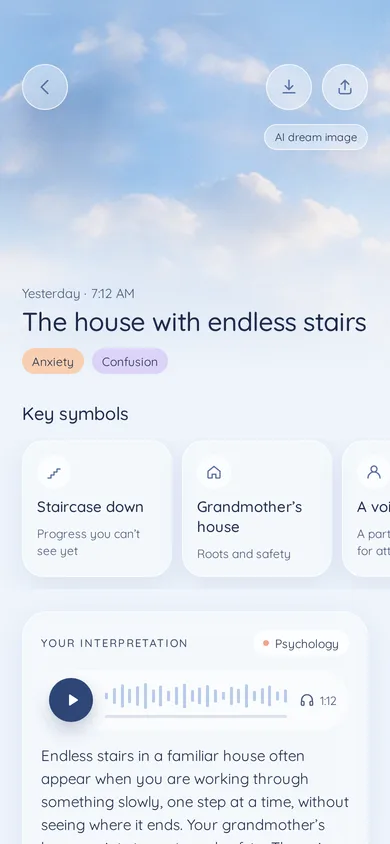
Our five-step method to interpret your dream puts these principles into practice. Dreamer is built on the same view: it asks how the dream felt, whether it repeats and who was in it before giving a reading, and its Psychology lens follows the research. Spiritual and Dream book readings sit alongside as clearly labeled cultural lenses. It is a reflection tool, not a scientifically proven test and not therapy. More in how AI dream interpretation works. And if dreams keep you from sleeping or living well, it is worth talking to a doctor or a therapist.
Frequently asked questions
Is dream interpretation scientific?
Some of it is grounded in science and some is not. The idea that dreams reflect your waking concerns and emotions is well supported, and so is the finding that a person's dream content is consistent over time. Universal symbol lists, prophetic readings and many of Freud's specific claims are not supported. Scientific dream interpretation is about patterns and emotions, not secret codes.
Is dream meaning true?
A dream meaning can be true for you in the sense that it accurately reflects what you are feeling or dealing with. It is not true in the sense of a fixed fact that applies to everyone, or a prediction. The best test is whether a reading helps you recognize something real in your life. If it does not fit, it is not your dream's meaning.
What does psychology say about dream interpretation?
Dream interpretation psychology today is less about decoding and more about exploring. Researchers see dreams as reflecting memory processing, emotional concerns and associations between memories. Therapists who work with dreams, using methods like Clara Hill's exploration, insight and action model, treat the dreamer as the expert on what fits. Reviews find this can increase insight, though the evidence is still limited.
How did Jung approach dream interpretation?
Carl Jung saw dreams as compensating for the conscious attitude - showing what the waking mind overlooks or undervalues. He worked with both personal symbols, unique to the dreamer, and collective symbols shared across cultures. Dream interpretation in the Jungian tradition asks what the dream adds to your waking view. His specific archetypes are not proven, but the idea of dreams balancing waking life remains influential.
Can dreams predict the future?
There is no scientific evidence that dreams predict the future. Dreams draw on your worries and expectations, so they sometimes match what happens next - you dream about a difficult conversation and then it goes badly. That feels prophetic, but the dream was reflecting a concern you already had. Remembering the hits and forgetting the misses makes the effect seem stronger than it is.
Sources
- Freud, S. (1900). The Interpretation of Dreams.
- Jung, C. G. (1964). Man and His Symbols. Doubleday.
- Hobson, J. A., & McCarley, R. W. (1977). The brain as a dream state generator: An activation-synthesis hypothesis of the dream process. American Journal of Psychiatry, 134(12), 1335-1348.
- Schredl, M., & Hofmann, F. (2003). Continuity between waking activities and dream activities. Consciousness and Cognition, 12(2), 298-308.
- Domhoff, G. W. (2003). The Scientific Study of Dreams: Neural Networks, Cognitive Development, and Content Analysis. American Psychological Association.
- Hall, C. S., & Van de Castle, R. L. (1966). The Content Analysis of Dreams. Appleton-Century-Crofts.
- Walker, M. P., & van der Helm, E. (2009). Overnight therapy? The role of sleep in emotional brain processing. Psychological Bulletin, 135(5), 731-748.
- Wamsley, E. J., Tucker, M., Payne, J. D., Benavides, J. A., & Stickgold, R. (2010). Dreaming of a learning task is associated with enhanced sleep-dependent memory consolidation. Current Biology, 20(9), 850-855.
- Zadra, A., & Stickgold, R. (2021). When Brains Dream: Exploring the Science and Mystery of Sleep. W. W. Norton.
- Cartwright, R., Young, M. A., Mercer, P., & Bears, M. (1998). Role of REM sleep and dream variables in the prediction of remission from depression. Psychiatry Research, 80(3), 249-255.
- Hill, C. E. (1996). Working with Dreams in Psychotherapy. Guilford Press.
- Pesant, N., & Zadra, A. (2004). Working with dreams in therapy: What do we know and what should we do? Clinical Psychology Review, 24(5), 489-512.
- Rozen, N., & Soffer-Dudek, N. (2018). Dreams of teeth falling out: An empirical investigation of physiological and psychological correlates. Frontiers in Psychology, 9, 1812.
Dreamer is a tool for reflection, not medical or psychological care. If dreams keep you from sleeping or living well, talk to a doctor or a therapist.