Interpret My Dream: How to Decode Any Dream in 5 Steps
The short answer
Can you interpret my dream? You can do it yourself in five steps: name the emotion the dream left you with, pick its three key symbols and what they mean to you, link it to the day or two before, check whether it repeats, and ask what has changed in your life lately. The answer is usually where those meet.
In this article
You wake up with a dream still hanging in the air - a strange house, someone you have not seen in years, a feeling you cannot shake - and you want to know what it was about. You do not need a dream book or a psychic for that. You need a method, ten quiet minutes and some honesty with yourself.
“Can you interpret my dream?” What a real reading needs
When people search “can you interpret my dream”, they usually hope for a single, definite answer. Real dream interpretation works differently. A dream is not a coded message with one solution; it is your mind replaying and recombining recent experiences, feelings and memories. A good reading finds the thread between the dream and your life.
To do that, any interpretation needs four ingredients:
- The emotion. How the dream felt is often more important than what happened in it.
- Your associations. What a symbol means to you, not what it means in a list.
- Your current life. What has been on your mind, what is changing, what you are avoiding.
- The pattern. Whether this dream or theme has shown up before.
A symbol dictionary has none of these. That is why it can tell everyone that water means emotions and still miss your dream entirely.
It also helps to know what interpretation cannot do. It cannot tell you what will happen, reveal what someone else secretly thinks or diagnose anything. So the honest answer to “can you interpret my dream?” is: yes, as a mirror for what you feel and what is on your mind right now. That is less magical than a prophecy, but far more useful - a mirror is something you can act on.
What sleep science says about interpreting dreams
Research does not offer a decoder ring, but it explains why the method below works.
Michael Schredl’s research on continuity shows that waking activities and concerns show up in dream content - the raw material comes from your life. A 2014 study by Malinowski and Horton found that emotionally intense waking experiences are more likely to be incorporated into dreams than neutral ones. That is why step one is the emotion, and step three is the day before.
Memory research adds another piece. Erin Wamsley and Robert Stickgold describe dreams as reflecting memory processing during sleep, mixing fragments of recent and older memories. Antonio Zadra and Robert Stickgold go further in When Brains Dream: dreaming explores weak, unexpected associations between memories. So when an old classmate appears in a dream about your new job, the question is what links them for you.
G. William Domhoff found that a person’s dream content is consistent over time and reflects their concerns and relationships, which is why repeats are worth tracking. And the structure of the method echoes Clara Hill’s approach to working with dreams in therapy - exploration, insight, action. A review by Pesant and Zadra found that dream work in therapy can increase insight and engagement, though the evidence is still limited. You are borrowing a gentle version of that process.
How to interpret a dream in 5 steps
Grab a notebook or your phone. Each step takes a minute or two.
Step 1: Name the emotion
Before thinking about symbols, ask: how did I feel in the dream, and how did I feel when I woke up? Pick one or two words - anxious, relieved, embarrassed, nostalgic, angry. If the feeling changed during the dream, note that too. This is your compass for every step that follows.
Step 2: Pick three key symbols and your associations
Choose the three images that stood out most: a person, a place, an object, an action. For each, write what it means to you, not to a dictionary. Your grandmother’s kitchen might mean safety, or criticism. A dog might mean loyalty, or the attack you remember from childhood. Your first association is usually the most useful one.
Step 3: Link it to the day before
Look at the last day or two. What conversation, worry, news or decision carried the same feeling as the dream? You are not looking for the same events - you are looking for the same emotional note. A dream of missing a train after a day of feeling left out at work is a common kind of match.
Step 4: Check whether it repeats
Have you had this dream before, or one with the same theme? Repeats point to a concern that keeps coming back. If you have no record, start one now: a 2016 study by Aspy found that keeping a logbook increases how many dreams people recall. For long-running dreams, see why you keep having the same recurring dream.
Step 5: Ask what has changed
Finally, ask: what has changed in my life recently, or what is about to? New roles, endings, moves and decisions are fertile ground for dreams. Put this answer next to steps 1-4 and write one sentence that starts with “Maybe this dream is about…”. Then ask whether it fits. If it does not, try another sentence.
A worked example
You dream you are back in school, cannot find the exam room and realize you never studied. Emotion: panic, then shame. Symbols: school (being judged), the lost room (not knowing where you belong), the exam (a test). The day before: your manager asked for a presentation next week. Repeats: the dream shows up before every review. What changed: a new role with more visibility. Reading: “Maybe this dream is about feeling evaluated in a role I do not feel ready for.” More on this plot in exam dreams.
| Step | Question to ask | Example answer |
|---|---|---|
| 1. Emotion | How did it feel, during and after? | Panic, then shame |
| 2. Symbols | What do the three key images mean to me? | School = being judged |
| 3. The day before | What carried the same feeling yesterday? | A presentation request |
| 4. Repeats | Have I had this dream or theme before? | Before every review |
| 5. What changed | What is new or ending in my life? | A more visible role |
Context changes the reading
The same dream can mean very different things for different people, or for you at different times. Three kinds of context matter most.
The emotion inside the dream. Flying with joy and flying in terror are different dreams. So are a calm encounter with a snake and a bite. See how the feeling shifts the meaning in flying dreams and snake dreams.
Your life chapter. Dreaming of a wedding when you are single, engaged or recently divorced points in three directions. The same goes for pregnancy, death and ex dreams - the image is the same, the life is not.
How often it comes. A one-time dream is often about this week. A dream that returns for months is usually about a pattern. Track it before drawing conclusions.
Who was in it. A specific person in a dream - a parent, an ex, a boss - often stands for a feeling or a role rather than for themselves. Ask what that person represents for you right now, and what your relationship with them felt like in the dream. Our guide to dreaming about someone goes deeper on this.
The spiritual and cultural view
Every culture has had its own way of answering “dream interpretation, please”. Ancient dream books listed symbols and their omens; many religious traditions treated certain dreams as guidance; folk beliefs still say that dreaming of a wedding means a funeral, or the reverse. These traditions are part of human history and can be meaningful to read.
What they share with the psychological method is the idea that dreams are worth attention. Where they differ is in who holds the meaning. A tradition gives a fixed answer; the five steps let you build your own. If spiritual readings speak to you, use them as one lens next to your own associations, not as a prediction. For where the evidence stands on each approach, see is dream interpretation real.
Free dream interpretation options, and a 30-second shortcut
You can interpret a dream for free in several ways:
- This method. Free, private and personal. Save the five questions in your notes.
- A dream journal. The more dreams you record, the clearer your patterns. Tips on catching more of them are in how to remember your dreams.
- Symbol dictionaries. Free dream interpretation online is easy to find. Use dictionaries for cultural background, not as the answer.
- A general chatbot. If you give it your notes from steps 1-5, it can help you reflect. Without them, expect a generic reading.
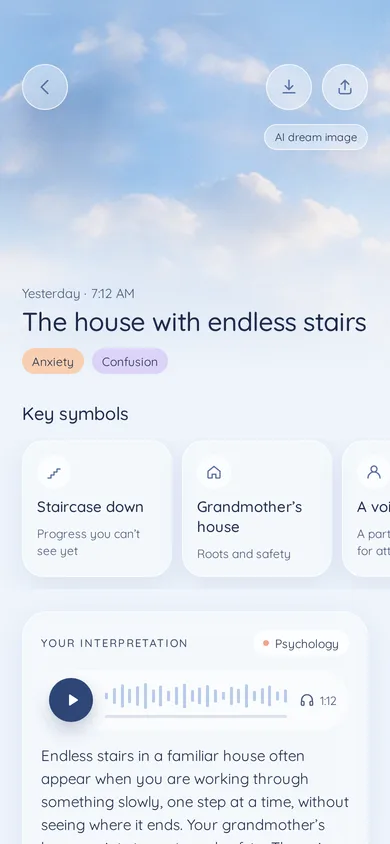
Or do it in about 30 seconds with Dreamer. Tell the dream out loud right after waking, mark how it felt, whether it repeats and whether someone specific was in it, and you get a personal reading in three lenses - Psychology, Spiritual and Dream book - the three key symbols, a short “For you, right now” note with a question, and a journal that shows your recurring themes over time. It starts with a 7-day free trial. Learn how it works in AI dream interpretation.
However you do it, treat the result as a question rather than a verdict. And if dreams keep you from sleeping or living well, it is worth talking to a doctor or a therapist.
Frequently asked questions
How can you interpret a dream on your own?
Start with the feeling, not the symbols: how did you feel in the dream and right after waking? Then list the three images that stood out and write what each one reminds you of personally. Look at the day or two before the dream, check whether you have had it before, and ask what has changed in your life lately. The meaning usually sits where those answers overlap.
Is there free dream interpretation online?
Yes. Dream dictionaries and symbol pages are free, general chatbots can give a reading if you describe the dream and your situation in detail, and the five-step method in this article costs nothing. Free tools differ mainly in how much context they take into account. A symbol list gives everyone the same answer; a method that starts from your feelings gives you yours.
Dream interpretation, please - where do I start?
Write the dream down first, before the details fade - a few lines or a voice note is enough. Add one word for the feeling and one line about what is going on in your life. Then work through the five steps here, or paste the same notes into an interpretation tool. The note you make in the first minutes after waking is the most valuable part.
Is free dream interpretation accurate?
Accuracy in dream interpretation is about fit, not truth: a good reading is one that helps you recognize something real in your life. Free symbol dictionaries often miss because they ignore emotion and context. Any method - free or paid - gets closer when it starts from how the dream felt and what is happening for you. No method can predict the future.
Can someone else interpret my dream better than I can?
Someone else can notice things you miss and ask good questions, which is what a skilled therapist or a thoughtful friend does. But you hold the key information: your associations, your feelings and your life. The best interpretations come from a conversation between an outside view and your own sense of what fits, not from an expert decree.
Sources
- Schredl, M., & Hofmann, F. (2003). Continuity between waking activities and dream activities. Consciousness and Cognition, 12(2), 298-308.
- Malinowski, J. E., & Horton, C. L. (2014). Evidence for the preferential incorporation of emotional waking-life experiences into dreams. Dreaming, 24(1), 18-31.
- Domhoff, G. W. (2003). The Scientific Study of Dreams: Neural Networks, Cognitive Development, and Content Analysis. American Psychological Association.
- Zadra, A., & Stickgold, R. (2021). When Brains Dream: Exploring the Science and Mystery of Sleep. W. W. Norton.
- Hill, C. E. (1996). Working with Dreams in Psychotherapy. Guilford Press.
- Pesant, N., & Zadra, A. (2004). Working with dreams in therapy: What do we know and what should we do? Clinical Psychology Review, 24(5), 489-512.
- Wamsley, E. J., & Stickgold, R. (2011). Memory, sleep and dreaming: Experiencing consolidation. Sleep Medicine Clinics, 6(1), 97-108.
- Aspy, D. J. (2016). Is dream recall underestimated by retrospective measures and enhanced by keeping a logbook? An empirical investigation. Consciousness and Cognition, 42, 181-203.
Dreamer is a tool for reflection, not medical or psychological care. If dreams keep you from sleeping or living well, talk to a doctor or a therapist.