Spiritual Meaning of Dreaming Your Teeth Fall Out
The short answer
The spiritual meaning of dreaming teeth falling out is usually change: something old is being shed so something new can grow, much like losing baby teeth. Many traditions also read it as loss or a worry about family. Research agrees the dream tracks real concerns and transitions - but finds no sign that it predicts events.
In this article
People have been trying to read this dream for thousands of years, long before anyone measured a brainwave. Those readings are worth knowing - not because they predict anything, but because they capture what the dream feels like from the inside. This guide puts the traditional lenses next to the research, so you can see where they meet and where they part.
What is the spiritual meaning of dreaming teeth falling out?
Across traditions, the spiritual meaning of dreaming teeth falling out tends to cluster around four ideas. Each one grows out of something real about teeth themselves.
Change and shedding. Every person loses their first teeth and grows new ones. That makes teeth one of the few body parts we naturally shed and replace, and many spiritual readings treat the dream the same way: an old version of you is loosening so a new one can come through. People often describe these dreams during a move, a graduation, a breakup or a career change.
Loss and family. Many folk traditions linked teeth to members of the household - a mouth is a row of closely set teeth, as a family is a row of closely tied people. In those readings, a lost tooth meant worry about a relative. Today this is better read as a sign of how much your close relationships are on your mind.
Strength and vitality. Teeth bite, chew and hold on. Losing them can symbolize losing your grip, your confidence or your sense of power. In some readings it marks aging, or a feeling of being worn down by what you carry.
Truth and speech. Teeth shape words. Some lenses read the dream as a nudge about honesty: something you need to say, or something you said that you cannot take back.
For the psychological side of the same dream - stress, control and the role of a clenched jaw - see our main guide on what teeth falling out dreams really mean.
What sleep science says about teeth dreams and meaning
Research does not test spiritual claims, but it does tell us a lot about the dream itself. First, it is common. A survey of 55 typical dream themes among Canadian students placed teeth falling out among the most frequent, along with being chased and falling. A dream that so many people share is unlikely to be a private message meant for one person - it is more likely a pattern in how human brains work.
Second, it has a body side. A 2018 study of teeth dreams found they were linked to dental irritation on waking, such as signs of clenching, and less clearly to psychological distress. Traditions that read teeth dreams as signs about strength and vitality were, in a sense, noticing the body without knowing it.
Third, dreams reflect waking concerns. The continuity hypothesis, supported by Schredl and Hofmann, shows that what you do and worry about while awake shows up in your dreams. And G. William Domhoff’s work on dream content found that it stays consistent within a person over time and reflects their concerns and relationships. That fits the family and change readings well: people dream about the relationships and transitions that matter to them.
Freud read dreams as disguised wishes, and Jung saw them as balancing the conscious attitude with personal and collective symbols. Research has not supported Freud’s specifics, but Jung’s idea of compensation - a dream of fragility arriving when you insist on being strong - remains a thoughtful question to ask.
Common teeth dreams and their spiritual meanings
Each version of the dream carries its own traditional reading. Here they are next to what each version often reflects psychologically.
Losing a single tooth
The spiritual meaning of dreaming losing a tooth, one at a time, is usually a specific ending: one bond, one role, one phase. Traditional readings sometimes tied it to a particular relative; a reflective reading asks which one thing is loosening in your life.
All your teeth falling out together
When the whole mouth goes, spiritual readings speak of a major transition or a “clearing” - many old things leaving at once. Psychologically, it tends to match feeling overwhelmed by several changes at the same time.
A baby tooth coming out
Dreaming of losing a baby tooth is one of the most hopeful versions. It points to growth: something you have outgrown is making room. It often appears when you are stepping into a more adult role.
Teeth falling out painlessly
No pain, no blood, sometimes even relief. Many readings take this as a peaceful release - you are ready for the change, even if it is a big one.
Teeth falling out with blood
Blood adds cost. Traditions often read it as a loss that touches the heart or the family; psychologically it tends to show up when a change is taking something real from you. For the difference between clean loss and damage, see what teeth breaking or crumbling means.
Teeth growing back
Rarer and striking. Spiritual readings see renewal and resilience. It often appears after a hard period, when you sense you are recovering.
Giving your teeth away or burying them
Some people dream of handing their teeth to someone or putting them in the ground. Traditional lenses read this as an offering or a deliberate letting go, and it often matches a conscious decision to end something.
Someone else’s teeth falling out
Watching another person lose their teeth moves the focus away from you. Traditional readings tie it to that person’s wellbeing; psychologically, it often reflects worry about them, or the shock of seeing vulnerability in someone you thought of as strong.
| Variant | Traditional reading | What it often reflects |
|---|---|---|
| One tooth | A specific ending, one relative | One concern or relationship on your mind |
| All teeth | Major transition, clearing | Several pressures or changes at once |
| Baby tooth | Growth, a new stage | Stepping into a more adult role |
| Painless loss | Peaceful release | Readiness to let something go |
| With blood | Loss touching the heart | A change that costs you something real |
| Growing back | Renewal, resilience | Recovery after a hard stretch |
| Giving them away | Offering, letting go | A deliberate decision to end something |
| Someone else’s teeth | Concern for that person | Worry, or seeing someone strong as fragile |
Your situation changes the meaning
A spiritual reading only works if it fits your life. The same image means one thing to a student leaving home and another to someone caring for an aging parent. Before choosing a lens, look at what is changing right now and how you feel about it.
Your background matters too. If you grew up with a tradition that read teeth dreams as bad news about family, that reading may be the first thing that comes to mind on waking, and the fear it brings can feel like part of the dream. It helps to separate the two: the dream showed you an image, and the meaning you reached for came from what you learned.
The emotion inside the dream is the best compass. Peace and relief point toward release and growth; dread and shame point toward a loss you are resisting or a part of yourself you fear showing. And if the dream keeps returning, the question shifts from “what does it mean” to “what is still unresolved” - we cover that in why the teeth falling out dream recurs.
The spiritual and cultural view: where traditions and research meet
It helps to be precise about where the old readings and the new research agree.
Where they agree. Both say the dream is about change, loss and relationships. Both treat feeling as central. Both see the body in the dream - traditions through vitality and strength, research through clenching and dental sensations. The spiritual meaning of dreaming teeth falling out and the psychological one often land on the same question: what in your life is ending?
Where they part. Many traditions read teeth dreams as omens - of a death, of money, of misfortune. No research supports dreams predicting events, and some of those readings say more about the fears of their era than about you. A respectful approach keeps the symbolism and drops the forecasting.
What you can take from both. Treat the dream as an invitation to reflect, not a verdict. If a spiritual frame helps you feel calmer or more connected, that is a good use of it. If it makes you anxious about the future, the research lens is the kinder one.
What to do after this dream
A few steps help you turn the dream into insight, whichever lens you prefer.
- Record it while it is fresh. How many teeth, how they fell, whether it hurt, who was there. Our guide on how to remember your dreams helps if they fade fast.
- Name the feeling. Relief, grief, fear, calm - this tells you whether the change feels like loss or release.
- Ask what is shedding. List anything in your life that is ending or loosening: a role, a habit, a relationship, an old belief about yourself.
- Try the therapist’s three steps. Clara Hill’s method for dream work moves from exploring the images, to insight about what they connect to, to one small action. You can do a light version on paper.
- Notice the body. If you wake with a sore jaw, the dream may have had a very physical starting point, and a dentist can tell you more.
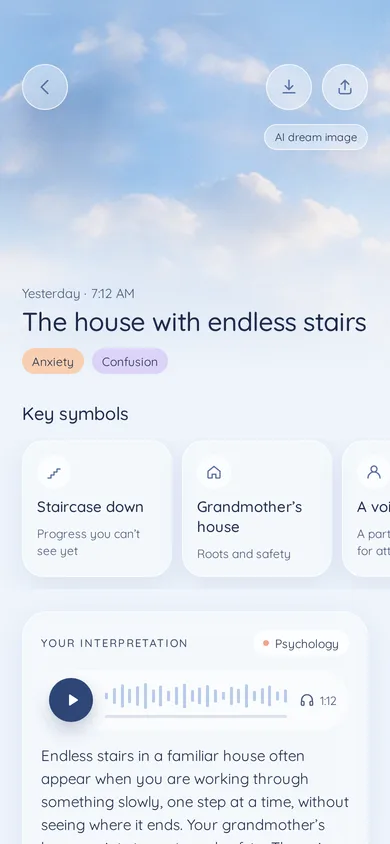
When you want to see your own dream through both lenses at once, an AI dream interpretation built on your details is a good place to start.
Frequently asked questions
What is the spiritual meaning of dreaming your teeth falling out?
In most traditions it is a dream about transition. Teeth are shed in childhood to make room for adult ones, so losing them in a dream is often read as an old stage ending. Other lenses read it as loss, a worry about family, or a call to speak more honestly. Which one fits depends on what is changing in your life right now.
What is the spiritual meaning of dreaming losing a tooth?
A single lost tooth is usually read more narrowly than a whole mouth: one relationship, one role or one habit that is coming to an end. Some folk traditions tied a single tooth to one particular relative. A reflective reading asks a gentler question - what one thing in your life feels loose right now, and are you ready to let it go?
Is dreaming of teeth falling out a bad omen?
No research shows that dreams predict deaths, illness or bad luck, and traditions that read teeth dreams as omens were reflecting the worries of their time. A more grounded view is that the dream mirrors your own concerns and body during sleep. If it frightened you, the useful question is what you are anxious about, not what is coming.
Do different cultures agree on what teeth dreams mean?
They agree on more than you might expect. Across very different traditions, teeth stand for family, strength, aging and growth, and losing them signals change. They disagree on whether the change is good or bad. That split mirrors how dreams actually work: the same image takes its meaning from the feeling and the situation around it.
Can a teeth dream be both spiritual and psychological?
Yes, and the two lenses often point the same way. A spiritual reading might call it a time of shedding; a psychological one might call it stress during a transition. Both ask you to look at what is ending in your life. Where they part ways is prediction - research supports reflection, not fortune-telling.
Sources
- Rozen, N., & Soffer-Dudek, N. (2018). Dreams of teeth falling out: An empirical investigation of physiological and psychological correlates. Frontiers in Psychology, 9, 1812.
- Nielsen, T. A., Zadra, A. L., Simard, V., Saucier, S., Stenstrom, P., Smith, C., & Kuiken, D. (2003). The typical dreams of Canadian university students. Dreaming, 13(4), 211-235.
- Schredl, M., & Hofmann, F. (2003). Continuity between waking activities and dream activities. Consciousness and Cognition, 12(2), 298-308.
- Domhoff, G. W. (2003). The Scientific Study of Dreams: Neural Networks, Cognitive Development, and Content Analysis. American Psychological Association.
- Jung, C. G. (1964). Man and His Symbols. Doubleday.
- Freud, S. (1900). The Interpretation of Dreams.
- Hill, C. E. (1996). Working with Dreams in Psychotherapy. Guilford Press.
Dreamer is a tool for reflection, not medical or psychological care. If dreams keep you from sleeping or living well, talk to a doctor or a therapist.