Dreaming About Tornadoes: What It Means
The short answer
What does it mean when you dream about tornadoes? Usually that something in your life feels chaotic and unpredictable - a conflict, a volatile person or your own swirling emotions. Unlike a slow threat, a tornado can turn at any moment, so the dream often reflects tension where you cannot tell where the damage will land.
In this article
A tornado dream rarely starts with the storm. It starts with a sky that looks wrong, a sound like a train, a siren somewhere in the distance. Then the funnel drops and you are running for a basement you are not sure exists. If you woke up wondering why your brain staged a disaster movie, you are in good company. Tornadoes are a common dream image even for people who have never seen one.
What does it mean when you dream about tornadoes?
The tornado has one feature no other storm has in the same way: you cannot predict its path. It can level one house and skip the next. That unpredictability is the core of most readings.
Chaos you cannot steer. The most common reading is a life that feels out of order. Too many moving parts, plans that keep changing, a schedule that does not hold. The tornado gives that feeling a shape and a sound.
Conflict and volatile moods. Tornado dreams often appear around people whose tempers flare without warning: a parent, a partner, a boss. The storm stands in for the tension of waiting for the next blowup and not knowing who will be hit. If the tornado formed in a specific place, like your childhood home or your office, that place is usually where the tension lives.
Your own destructive emotions. Sometimes the storm is you. Anger, frustration or panic that you keep under a calm surface can spin up into a funnel in dreams. People who say “I never get angry” are sometimes the ones who dream of tornadoes tearing through their own living room.
Sudden change. A tornado can rearrange a whole neighborhood in minutes. Dreams of the aftermath, with debris and a changed landscape, often follow abrupt life events: a sudden move, a breakup, a job that ended overnight.
So, what does it mean when you dream about tornadoes in your case? Usually the answer is in where the funnel was, who was with you and whether you felt it was coming for you or for someone else.
What sleep science says about tornado dreams
Dream researchers do not treat a tornado as a fixed symbol, but several well-studied ideas explain why this plot appears.
The continuity hypothesis says waking concerns show up in dreams. A 2003 study by Michael Schredl and Hofmann found that daytime activities and worries leave traces in dream content. That includes the literal: people who live in tornado regions, have just watched storm footage or lived through a warning are more likely to borrow the image. But for most people the storm is emotional weather, not literal weather.
The classic Hall and Van de Castle coding system, the standard way researchers have analyzed dream reports since 1966, has categories for misfortunes and aggression. A tornado dream scores on both: something bad happens to the dreamer, and a force acts on them violently. Content analysis has shown that these elements are a normal part of dream life, not a sign that something is wrong with you.
Antti Revonsuo’s threat simulation theory proposes that dreams rehearse how we spot and escape threats. The tornado script is a textbook drill: notice the warning signs, find shelter, protect others. Your brain may be practicing the response more than describing your fate.
Why does a tense dinner become a storm? Allan Hobson and Robert McCarley’s activation-synthesis model held that bursts of brainstem activity in REM sleep are woven by the forebrain into a story. Spinning sensations, rushing sounds and fast scene changes fit naturally into a whirling-storm plot. Antonio Zadra and Robert Stickgold’s NEXTUP model adds that dreaming explores weak, unexpected associations between memories. Your mind links “tense argument” with “dark sky” and “nowhere safe to stand,” and the result is a tornado. G. William Domhoff’s research shows that dream themes stay consistent within a person while their concerns stay the same, which is why the storm returns during stretches of ongoing conflict.
Common tornado dreams and what each one means
Hiding from a tornado
You are in a basement, a bathtub or under a table, waiting for the roar to pass. This version is about self-protection. It often appears when you are bracing yourself in a situation you cannot change, such as a family conflict or a job you cannot leave yet. The shelter you chose matters: a solid basement suggests you trust your coping, a flimsy closet suggests you are not sure it will hold.
Watching a tornado from a window
You see it coming across a field and you cannot look away. Watching is common when the chaos is in someone else’s life - a sibling’s crisis, a friend’s divorce, a parent’s illness. You are close enough to be afraid and far enough to feel helpless. Some people also have this dream when they can see a problem forming at work but nobody listens to their warning.
A tornado hitting your house
When the storm targets your home, the dream usually points to private life: family, relationships, your sense of safety. If you have also dreamed of your house on fire, the two often share a theme of something personal under threat, but the tornado version leans more toward outside forces and the fire version toward something that burns from inside.
Being picked up by a tornado
You are lifted off the ground and spun. This variant is about loss of footing and identity in the middle of change. It shares something with falling dreams: the ground is gone and you have no say in where you land. It is common during transitions like starting college, a move abroad or the first months with a new baby.
Multiple tornadoes
Two, three, five funnels across the horizon. Several tornadoes usually mean several stressors at once, with no single one to focus on. Pay attention to which one frightened you most; it often maps to the concern that matters most.
Chasing a tornado
Some dreamers drive toward the storm. This can reflect a pull toward drama or risk, or the opposite: a determination to face a problem head on instead of waiting for it to arrive. How it felt decides which. Excitement suggests the first, grim focus suggests the second.
A tornado that misses you
The funnel passes a few yards away and moves on. Near-miss dreams often follow near-miss weeks: a round of layoffs you survived, a fight that did not escalate, a scare that turned out fine. The body is still releasing the tension.
The aftermath
You walk through debris after the storm. Aftermath dreams tend to appear after a crisis has peaked. They can feel sad, but they often mark the start of sorting through what is left and deciding what to rebuild.
| Variant | What it often reflects |
|---|---|
| Hiding from a tornado | Bracing yourself in a situation you cannot change yet |
| Watching from a window | Chaos in someone else’s life, or a warning nobody hears |
| Tornado hits your house | Threat to home, family or private life from outside |
| Picked up by a tornado | Losing your footing during a big transition |
| Multiple tornadoes | Several stressors at once |
| Chasing a tornado | Pull toward risk, or resolve to face a problem |
| A tornado that misses you | Releasing tension after a near miss |
| Walking through the aftermath | Taking stock after a crisis has peaked |
Context changes the meaning
A tornado is always loud, but the honest answer to “what does it mean when you dream about tornadoes?” shifts with three things.
The emotion inside the dream. Fear points to a stressor you feel exposed to. Anger, if you were furious at the storm or at someone in it, can suggest the storm is your own frustration. Strange calm while everything spins sometimes appears in people who have learned to go numb during conflict.
Your waking situation. A tornado dream during a heated custody dispute and one during a busy product launch are not the same dream. Ask where in your life things change direction without warning, or where someone’s mood sets the weather for everyone else.
Frequency. One storm after a tense week is ordinary. Tornadoes every few nights for months suggest a pattern that has not been addressed. A recurring dream often softens once the real situation changes or once you start working with it directly.
The spiritual and cultural view
Wind and breath are linked to spirit in several languages: the Hebrew ruach and the Greek pneuma both carry both meanings. In the Book of Job, God answers Job out of a whirlwind, and for some readers that makes the tornado an image of a force far bigger than personal plans. In a spiritual reading, a tornado dream can be framed as a time of upheaval that clears the ground for something new.
Popular culture adds its own layer. In The Wizard of Oz, a tornado carries Dorothy out of an ordinary life into a strange, vivid one. Many people absorb that story early, and it can color their dreams: the storm as a door, frightening but transformative.
These readings can be meaningful ways to reflect on change. They work best as one lens among others, not as proof that a dream is a message from outside.
What to do after this dream
- Write down the storm. Where it formed, how many funnels, where you were, how it ended. Small details like the color of the sky often carry the emotional tone.
- Name the feeling. Fear, anger, helplessness, excitement. One word is enough.
- Find the storm in your day. Ask where life feels unpredictable, or whose mood you are tracking. Clara Hill’s structured approach to dreams in therapy moves from exploring the images, to insight, to a concrete action, and the same order works on your own.
- Pick one thing you control. Tornado dreams thrive on helplessness. Choosing one small action, like setting a boundary in a conversation, often reduces the charge.
- Watch for repeats. Note whether the storms get closer, weaker or farther away over time.
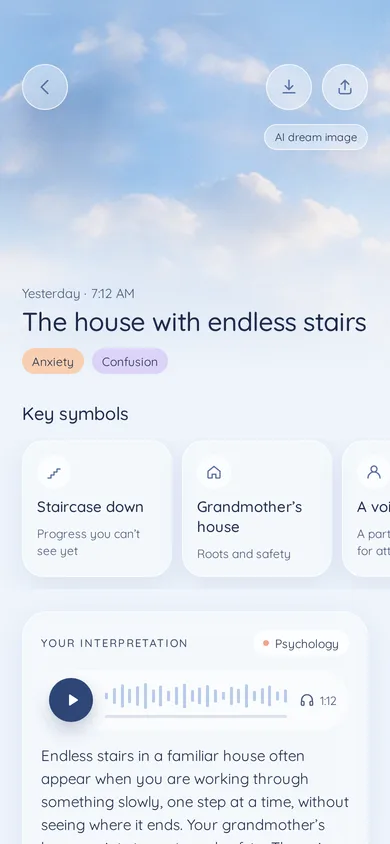
If dreams keep you from sleeping or living well, it is worth talking to a doctor or a therapist. You might also find it useful to compare this dream with giant wave dreams, earthquake dreams and being chased, or try AI dream interpretation for your own version.
Frequently asked questions
What is the meaning of a dream about a tornado?
A dream about a tornado usually reflects chaos you cannot steer: an argument that keeps flaring, a household with unpredictable moods, or emotions that spin faster than you can name them. The details refine it. Hiding suggests self-protection, watching suggests worry from a distance, and being caught inside suggests you feel pulled into a conflict that is not fully yours.
What is the dream meaning of a tornado that keeps missing you?
A tornado that keeps missing you often shows up in near-miss periods: a layoff round you survived, a family fight you stayed out of, a health scare that turned out fine. The dream replays the tension of almost being hit. It can also reflect a lingering sense that your luck will run out, which is worth noticing rather than believing.
Why do I keep dreaming of a tornado?
Repeated tornado dreams usually track a situation that keeps flaring up in waking life - a relationship with regular blowups, a chaotic job or ongoing family tension. Dream content tends to stay consistent while the underlying concern stays the same. If the storm changes, for example you find shelter or it weakens, your situation or your coping may be changing too.
What do multiple tornadoes in a dream mean?
Several tornadoes at once usually mirror several stressors arriving together, with no single one to brace for. People often have this version during moves, exam seasons, busy holidays or when work and family crises overlap. The useful question is which tornado scared you most, because that one usually points to the stressor that matters most right now.
Is dreaming of a tornado a bad sign?
No. A tornado dream is not an omen and cannot predict a storm or a disaster. It is your brain processing tension, conflict or change. Many people dream of tornadoes during stressful but ultimately fine periods. Use the dream as a prompt to check where things feel out of control and what part of that you can actually influence.
Sources
- Hall, C. S., & Van de Castle, R. L. (1966). The Content Analysis of Dreams. Appleton-Century-Crofts.
- Schredl, M., & Hofmann, F. (2003). Continuity between waking activities and dream activities. Consciousness and Cognition, 12(2), 298-308.
- Hobson, J. A., & McCarley, R. W. (1977). The brain as a dream state generator: An activation-synthesis hypothesis of the dream process. American Journal of Psychiatry, 134(12), 1335-1348.
- Revonsuo, A. (2000). The reinterpretation of dreams: An evolutionary hypothesis of the function of dreaming. Behavioral and Brain Sciences, 23(6), 877-901.
- Zadra, A., & Stickgold, R. (2021). When Brains Dream: Exploring the Science and Mystery of Sleep. W. W. Norton.
- Domhoff, G. W. (2003). The Scientific Study of Dreams: Neural Networks, Cognitive Development, and Content Analysis. American Psychological Association.
- Hill, C. E. (1996). Working with Dreams in Psychotherapy. Guilford Press.
Dreamer is a tool for reflection, not medical or psychological care. If dreams keep you from sleeping or living well, talk to a doctor or a therapist.